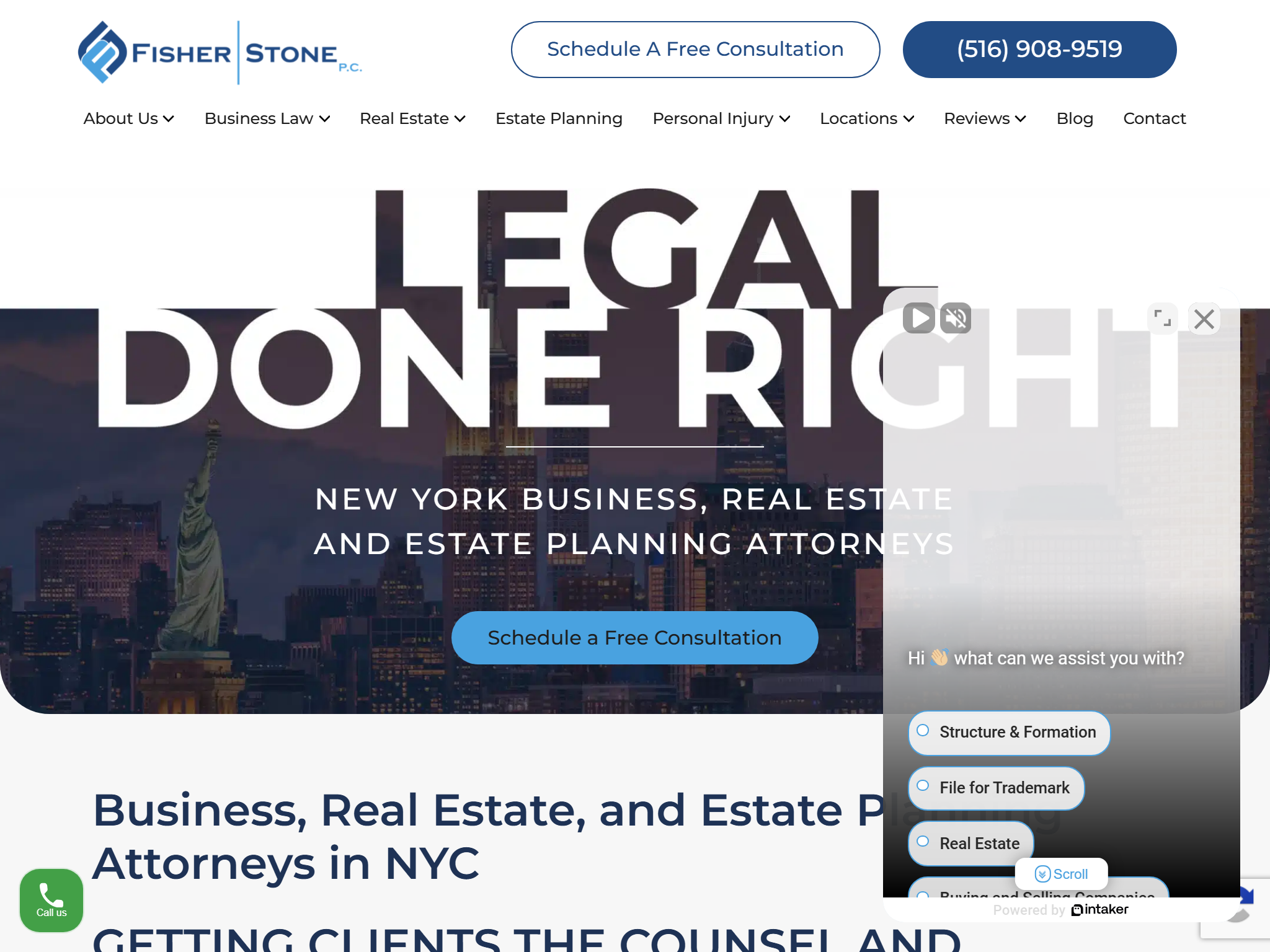
Fisher Stone has real expertise — 157+ five-star reviews, two founding partners with hands-on business experience, and three offices across New York City. But the website that represents all of this scores 45 out of 100 across performance, design, and AI visibility. The site reads as a WordPress template with a chatbot widget that covers 40% of the mobile screen. When AI systems are asked to recommend NYC business attorneys, Fisher Stone doesn't appear. The website is actively undermining the firm it's supposed to represent.
A business owner in Manhattan needs help structuring an LLC. They Google "NYC business attorney," find Fisher Stone, and tap the link on their phone.
5.6 seconds pass. They're staring at a blank screen. The page hasn't painted a single pixel. Their thumb is already hovering over the back button.
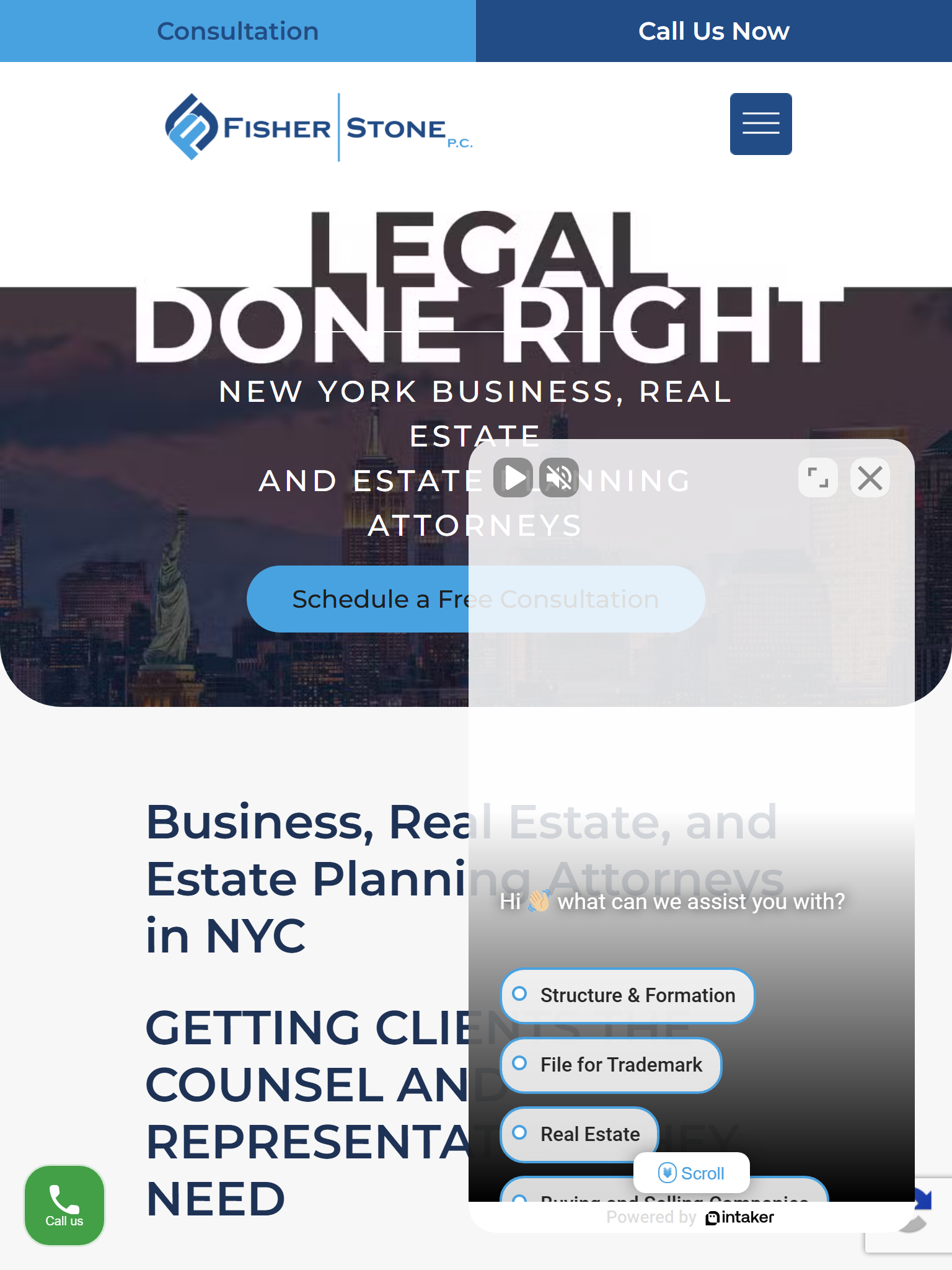
11.5 seconds later, the hero section finally appears — "LEGAL DONE RIGHT" over a New York skyline. But before they can read the subheading, a chatbot widget slides open and covers 40% of their screen. The CTA button is now partially hidden behind the chat window.
By the time the full page finishes loading at 17.7 seconds, most visitors have already left. Google's own research shows 53% of mobile visitors abandon a site that takes longer than 3 seconds to load. Your site is nearly 6x over that threshold.
You represent businesses, negotiate real estate deals, and plan estates. Your website scores 48/100 on design quality — lower than most off-the-shelf templates. Here's how that breaks down across 10 categories of visual design:
The "LEGAL DONE RIGHT" headline is bold and confident — it communicates a firm that takes itself seriously. But everything surrounding it (the chatbot overlay, the generic blue palette, the stock photography, the six competing CTAs) communicates "WordPress template purchased last year." Prospective clients subconsciously register this gap. They're looking for trusted legal counsel, but the website communicates budget.
Every issue identified in this audit has a business consequence. Here's what these scores actually mean for Fisher Stone:
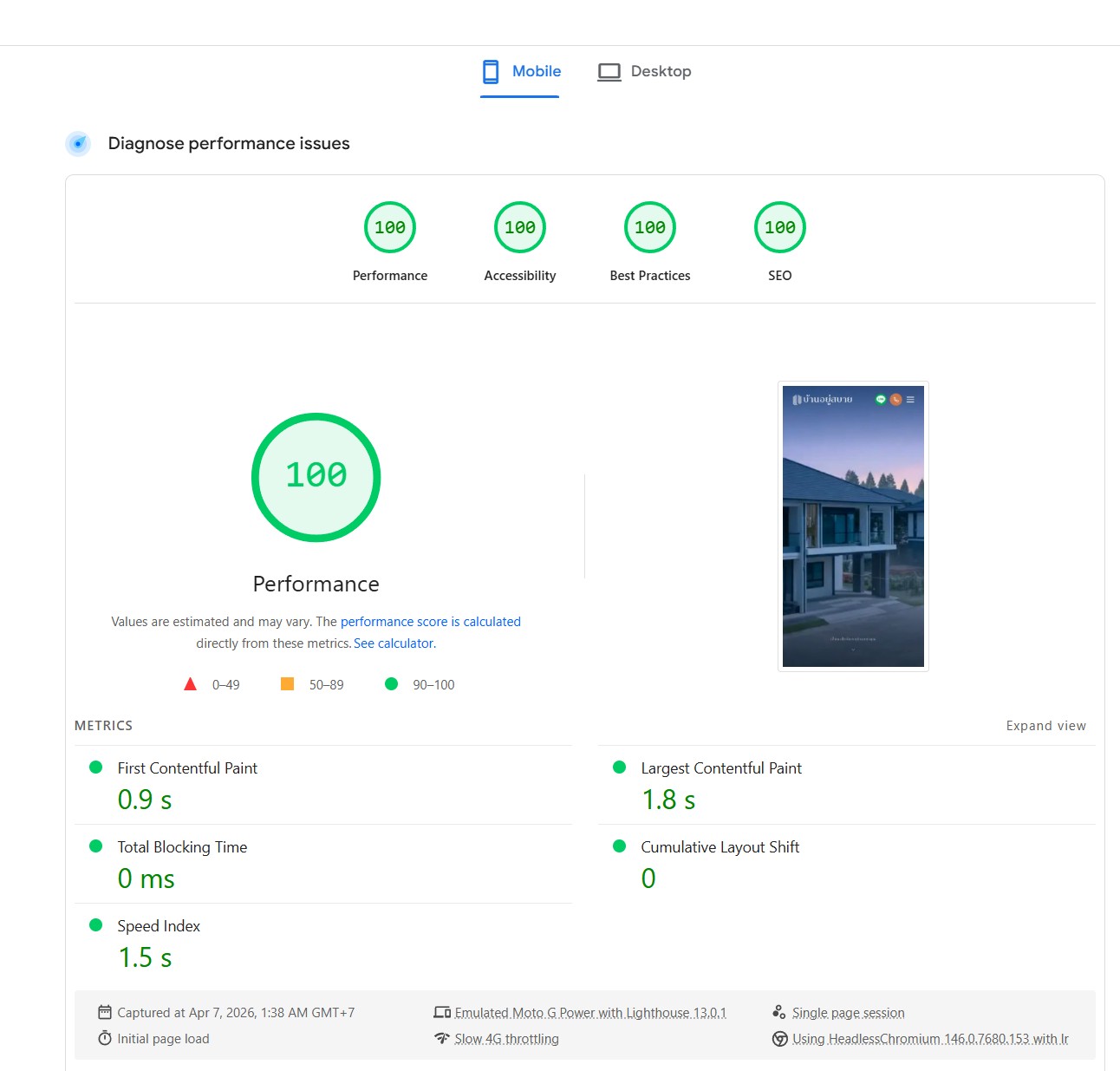
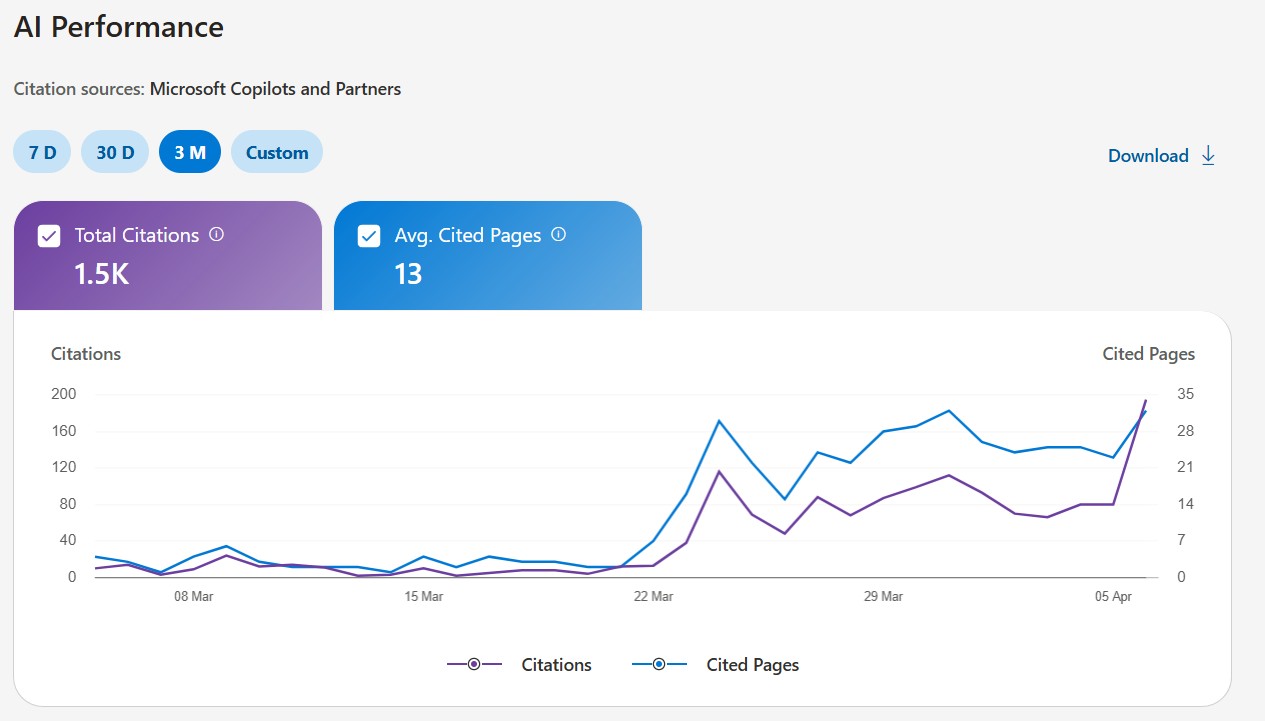
The gap between 45 and 93+ isn't cosmetic. It represents the difference between a website that loses clients before they see your expertise, and one that converts interest into consultations. Performance at 100 means instant loading on any device. Design at 90+ means every pixel communicates the professionalism your reviews prove. AI Visibility at 90+ means when someone asks an AI assistant about business attorneys in NYC, Fisher Stone is the name that comes up. Your expertise, your reviews, your track record — all of it is already there. It's the infrastructure, design, and discoverability layer around it that's holding everything back.
AI-powered search (ChatGPT, Perplexity, Google AI Overviews, Gemini) is rapidly replacing traditional search for high-intent queries like "best business attorney NYC." Here's how your site performs across 6 dimensions of AI visibility:
Fisher Stone has 134 indexed pages including 80 blog posts — that's decent volume. But the content is thin, with generic marketing copy instead of quotable expert analysis. No author attribution on blog posts. No FAQ schema despite having FAQ content on the homepage. No llms.txt file. Duplicate meta descriptions across practice area pages. The foundation for AI visibility exists (content volume, directory presence, positive reviews) — but none of it is structured for AI systems to discover and cite.
Same methodology. Same standards. Here's what happened.
This report was produced using three independent analysis methods: Google Lighthouse 12.x for performance, accessibility, best practices, and technical SEO metrics (mobile emulation, throttled 4G); multi-breakpoint visual analysis across 6 device sizes (375px – 1920px) for design evaluation; and proprietary GEO scoring across 6 dimensions of AI visibility including citability, structured data, platform optimization, and content quality.
All scores are based on live data collected on 9 April 2026. Scores may vary with subsequent changes to the website. This report presents findings and analysis only — it does not constitute technical consulting or prescribe specific implementations.
This report identifies what's holding your website back. The next step is a conversation about what moving forward looks like.
Schedule a Conversation